What the STEPS survey reveals about health in Botswana
Gaborone—Botswana’s health profile is changing—and not always in ways we would hope. In September 2025, the Ministry of Health, working with the World Health Organization (WHO), released preliminary findings from the latest STEPS survey, a national study that looks at risk factors for noncommunicable diseases (NCDs) such as heart disease, diabetes and cancer. Conducted between March and September 2024, the survey provides the clearest picture yet of how lifestyle choices, access to care and long‑term health trends are shaping the lives of Batswana today.
When compared with the last national STEPS survey in 2014, the results tell a story of slow progress, missed opportunities, and growing pressure on the health system.
Smoking down—but tobacco still common
There is some good news. Daily smoking has declined over the past decade, suggesting that tobacco control efforts are having an effect. Today, about one in five adults uses tobacco, with smoking still far more common among men than women. However, overall tobacco use remains high, and the survey highlights a quieter trend: increased use of smokeless tobacco, particularly among women. This means tobacco remains a significant driver of preventable disease, even as smoking habits slowly change.
Alcohol use is rising
Alcohol tells a less encouraging story. The 2024 survey shows that more adults are drinking now than ten years ago, and heavy episodic drinking remains common—especially among men. While binge drinking has edged down slightly since 2014, the growing number of people who drink alcohol increases the overall risk of injuries, liver disease and cardiovascular conditions.
Diet and salt: little has changed
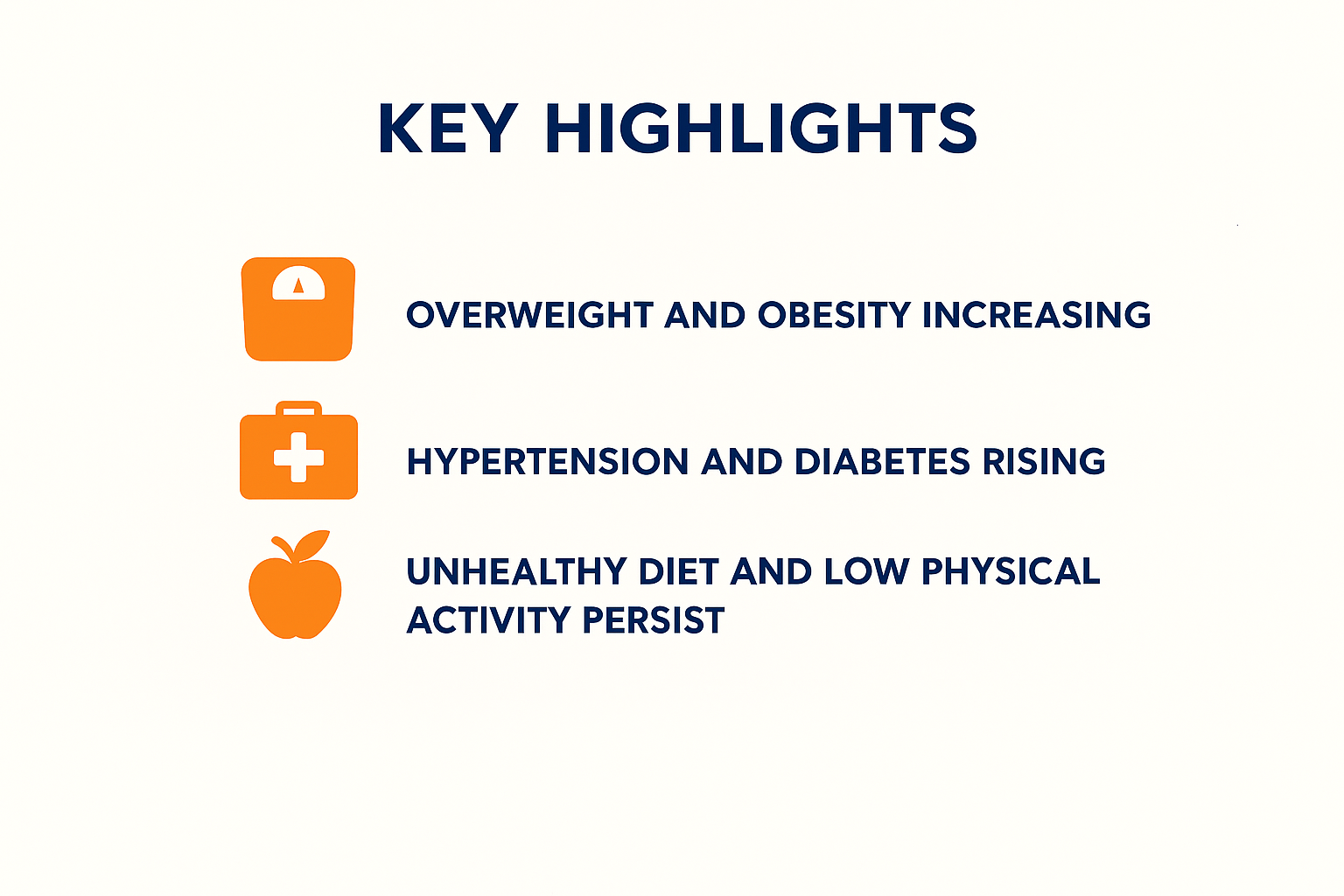
Despite years of health messaging, eating habits remain stubbornly unhealthy. Nine out of ten adults still eat too few fruits and vegetables, almost unchanged from 2014. Average salt intake is nearly double WHO’s recommended maximum, increasing the risk of high blood pressure and heart disease.
These patterns suggest that individual awareness alone is not enough—affordability, availability and food environments matter.
People are moving more—but sitting too
On physical activity, there are signs of modest progress. Fewer adults are classified as physically inactive compared to a decade ago. Yet more than half of adults report no leisure‑time exercise at all, particularly women. This suggests that while work or transport may involve movement, active lifestyles are not yet embedded in daily routines.
Weight, blood pressure and diabetes are rising threats
One of the most striking trends is the rise in overweight and obesity, especially among women. Nearly half of adults are overweight, and more than one in five is obese—a sharp increase since 2014.
This is reflected in high levels of hypertension. Almost four in ten adults now have high blood pressure, but only a small proportion have it under control. Diabetes affects a smaller share of the population, but control remains poor, increasing the risk of complications such as strokes, heart attacks and kidney disease.
The message is clear: detecting disease is not enough—long‑term treatment and follow‑up must improve.
Mental health and women’s health come into focus
For the first time, the STEPS survey also highlights mental health. Nearly 6% of adults report symptoms consistent with depressive disorders, signaling a growing need to integrate mental health services into primary care.
The survey also shows progress in cervical cancer screening, with around six in ten women aged 30–49 having been screened at least once. While encouraging, this still leaves many women unreached.
A decade of data, a moment for action
Taken together, the 2024 STEPS findings show that Botswana has avoided some of the worst health outcomes—but slow change is not enough. Without stronger action on diet, alcohol, physical activity and early treatment of NCDs, the burden on families, communities and the health system will continue to grow.
The data are clear. The challenge now is to turn evidence into action—through stronger prevention policies, better primary health care, and healthier environments that make the right choice the easy choice.
External Relations and Partnerships Officer
email: birsanc [at] who.int (birsanc[at]who[dot]int)
Tel: +26774620807